Why Gryps Is Becoming Agent-Native
Trading software is beginning to act on behalf of people. Gryps is building the private execution, live market data, and risk controls those agents will need.

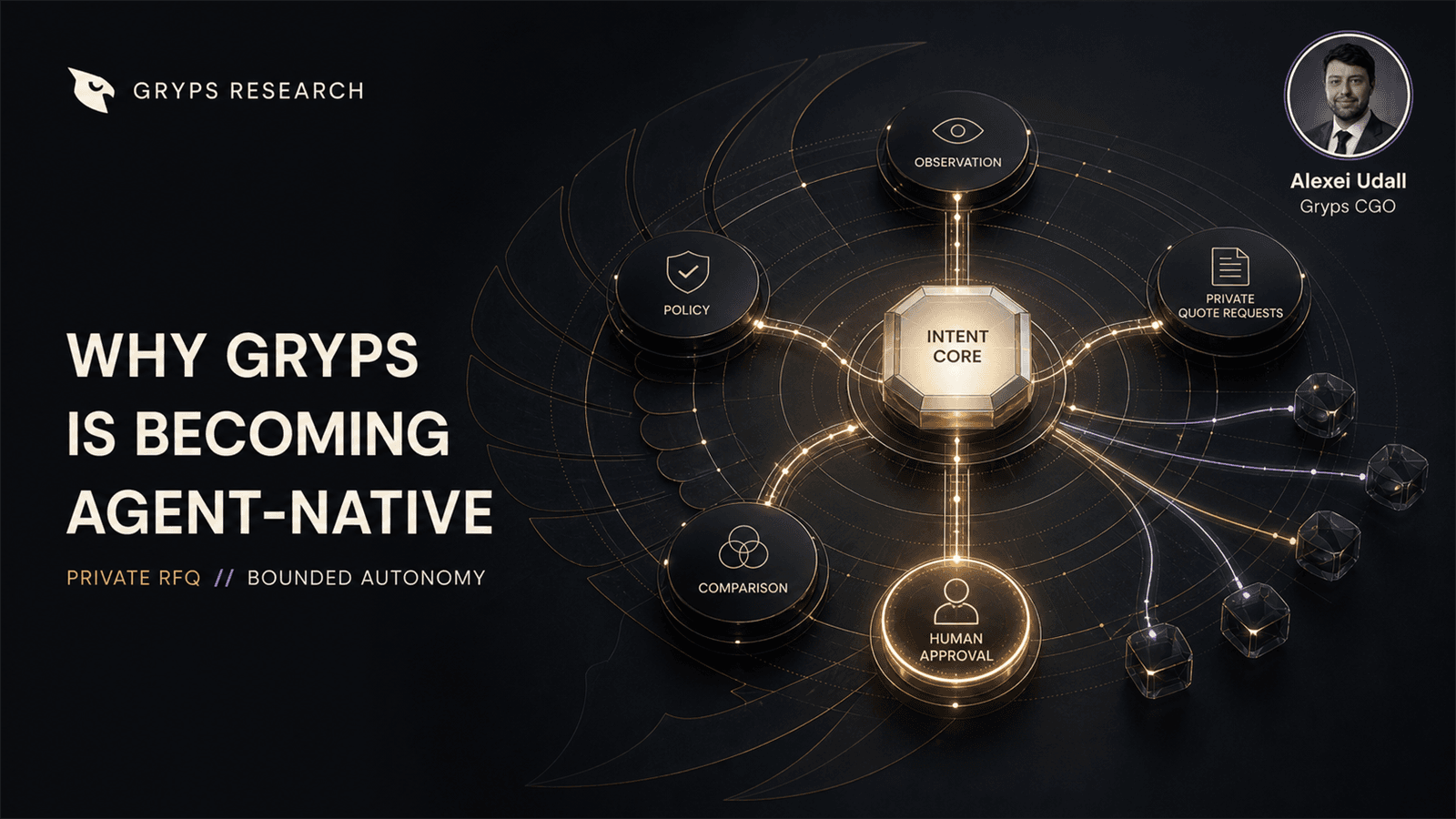
Most conversations about agentic trading start with the model.
Can it find a trade? Can it read the market? Can it act quickly enough?
Those are useful questions. They are not the hard bit.
The hard bit is everything around the model: what it is allowed to do, which data it can trust, how it asks for a price, what happens when a system changes, and where a human needs to step in.
That is the direction Gryps is heading.
We are building a perps product for people today. Over time, more of the work around a trade will be prepared and carried out by software acting on a person's behalf.
The market structure underneath Gryps is unusually well suited to that shift.
A trading agent needs more than a buy button
A normal trading interface assumes a person is looking at the screen.
The person sees a price, checks the size, decides what they are willing to risk, and presses the button. A lot of judgement sits outside the software.
An agent changes the shape of the problem. It needs those boundaries to be explicit.
It needs to know which markets are available, what the current fees and limits are, how fresh the data is, what authority it has, whether a quote is firm, what to do when the result is unclear, and when to stop and ask for help.
Giving an agent an API is easy. Giving it a safe way to operate is real work.
Private RFQ is a natural fit for agents
The Gryps execution model starts with intent.
A trader says what they want to achieve. That intent can be sent privately to competing solvers. The solvers return firm quotes. The trader, or an approved system acting for them, can compare those quotes before anything settles.
That sequence maps cleanly to how an agent should work.
Observe the market. Apply a policy. Prepare an intent. Request prices. Compare executable outcomes. Escalate when the decision falls outside a defined boundary. Approved execution comes later.
There is no need for the agent to spray orders across public books and hope the result matches the plan. It can ask a precise question and receive a price it can evaluate.
This matters even more as Gryps develops the brokerage layer described on the website. Multi-venue trading creates more choice, but also more wiring. Different venues expose different fees, limits, timing, and failure modes. A person can learn some of that through experience. An agent needs the rules in a form it can read.
The first pieces already exist
The agentic direction is not starting from a blank page.
We have built and internally tested a read-only connection that lets an AI client inspect live Gryps market information, including markets, fees, funding parameters, open interest, and venue status. It is internal tooling, not a public product today. Read-only is deliberate. It gives software useful visibility without giving it trading authority.
We have also built the first internal version of an agent SDK. Its live functionality is limited to reading market and venue information. The design specifies how future write operations should behave: configuration is explicit, repeated actions need strong idempotency keys, and an ambiguous result must remain "unknown" rather than being treated as success or failure. The write transport is not operational and fails loudly while the production interface and approved agent route are still being prepared.
Around that sits a machine-readable quirks registry. Venues have their own oddities, and those oddities matter. Fees can differ by symbol. Endpoints change. A market can look available while part of the route is not. An automated system needs to know the difference.
An API drift monitor also exists in the internal toolkit. It is designed to check the live structure and the values our software depends on, then report when something changes. It still needs to be wired into the production operating cadence. The point is to make upstream changes visible before an agent depends on stale assumptions.
None of this sounds as exciting as an autonomous trading demo.
That is probably a good sign.
The direction from here
The near-term path is deliberately staged.
First, the internal tools can observe. They can read live markets, fees, funding, limits, and venue health without placing a trade.
Then they can prepare. They can help a trader turn a mandate into a structured intent, compare possible routes, and explain the trade-offs.
After that may come bounded execution. The intended model gives an agent limited authority, a defined risk envelope, and time-boxed permissions. It must stop when the result falls outside what it understands. That write path is not available today.
Multi-venue coordination follows the same pattern. The agent should not decide that "best" means the biggest number on a screen. It needs to account for executable price, size, fees, route health, settlement conditions, and the policy set by the person or organisation using it.
The goal is not autonomy for its own sake. The goal is useful delegation.
Humans still own the judgement
Markets have a way of exposing weak assumptions.
Data gets stale. APIs change. Liquidity disappears. A quote looks attractive for a reason the system has not understood. Two actions race each other. A result comes back without enough information to know whether it completed.
That is why the Gryps agentic work puts so much weight on permissions, idempotency, explicit unknown states, monitoring, and kill switches.
A good agent should make a capable person more effective. It should carry out the repeatable parts, show its work, and know when the situation needs judgement.
The human role does not vanish. It becomes clearer.
This is part of Gryps, not a side project
Gryps is a retail perps DEX with private, institutional-grade RFQ execution. Retail traders remain a core audience. The product will also serve professional traders, solvers, protocols, and organisations with more complex flow.
The agentic layer extends the same architecture.
In the intended model, a person can submit an intent through an interface. A treasury system could prepare one from a hedge policy. A trading team could ask an agent to monitor risk and request quotes. A protocol could route flow programmatically.
The participant changes. The execution workflow holds.
That is the useful part of building around intent rather than around a screen.
What comes next
The immediate work is practical.
Keep the read layer reliable. Keep venue changes visible. Make the policy and risk controls legible. Work with the production trading interface rather than pretending it is stable before it is. Move towards write access only when the permissions, failure handling, and route are ready.
There are several possible product shapes from there.
One is a better Gryps interface, where agents help people research, prepare, and manage trades.
Another is a developer layer that lets other products use Gryps as private execution infrastructure.
A third is an operator product for teams that need to supervise several agents, venues, or strategies in one place.
The likely outcome is some blend of these, weighted by what proves useful.
Trading interfaces were built for hands on a keyboard. The next one may begin with a mandate: watch this risk, stay inside these limits, ask for prices, and bring me the decision when judgement is needed.
Gryps is building the execution layer underneath that future.